A LongForm
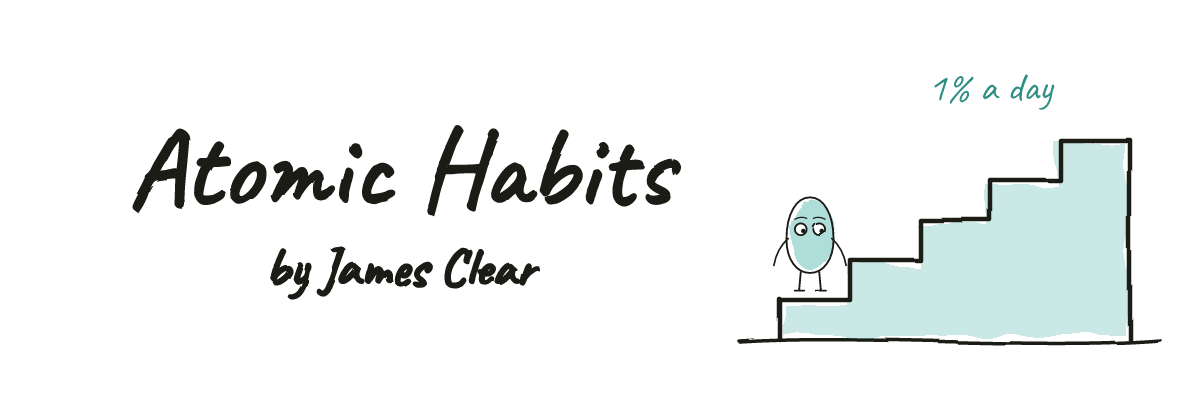
Atomic Habits by James Clear
Tiny changes repeated every day build a different person, and four simple rules decide whether they stick.
November 12, 2026
For nearly a hundred years, British road cycling was mediocre at best. Since 1908, the country had won a single Olympic gold medal in the sport. In 110 years, no British rider had won the Tour de France. One of Europe's top bike makers even refused to sell bikes to the team. It feared that other pros would see the Brits riding its gear and stop buying.
In 2003, the team hired Dave Brailsford as its performance director. Brailsford had one idea. Break down everything that goes into riding a bike, and make each piece 1 percent better.
So they redesigned the seats. They rubbed alcohol on the tires for a better grip. They tested massage gels. They hired a surgeon to teach every rider how to wash their hands, so the riders would catch fewer colds. They found the best pillow and mattress for each rider's sleep. They even painted the inside of the team truck white, so that any speck of dust would show up before it could harm the bikes.
Five years later, in Beijing, the team won 60 percent of the gold medals on offer in road and track cycling. In 2012, Bradley Wiggins became the first British rider to win the Tour de France. Between 2007 and 2017, British cyclists won 178 world championships and sixty-six Olympic or Paralympic gold medals.
Nobody got 60 percent better at cycling in one move. Hundreds of tiny moves added up.
That is the idea behind Atomic Habits, James Clear's book on how habits work and how to change them.
By the end, you will discover:
- why getting 1 percent better every day makes you 37 times better in a year, and why you feel nothing for months first (1, 2)
- why a goal cannot be what separates winners from everyone else, and what does (3)
- how every small action becomes a vote for the person you are turning into (4)
- why willpower is a weak plan, and what to change in your surroundings instead (8, 9)
- how to start a habit so small it cannot fail, what to do on the day you slip, and how to keep it alive when it turns boring (15, 18, 21)
Small changes add up, for you or against you
Get 1 percent better every day for a year, and you end the year about 37 times better. Get 1 percent worse every day, and you slide to almost nothing.
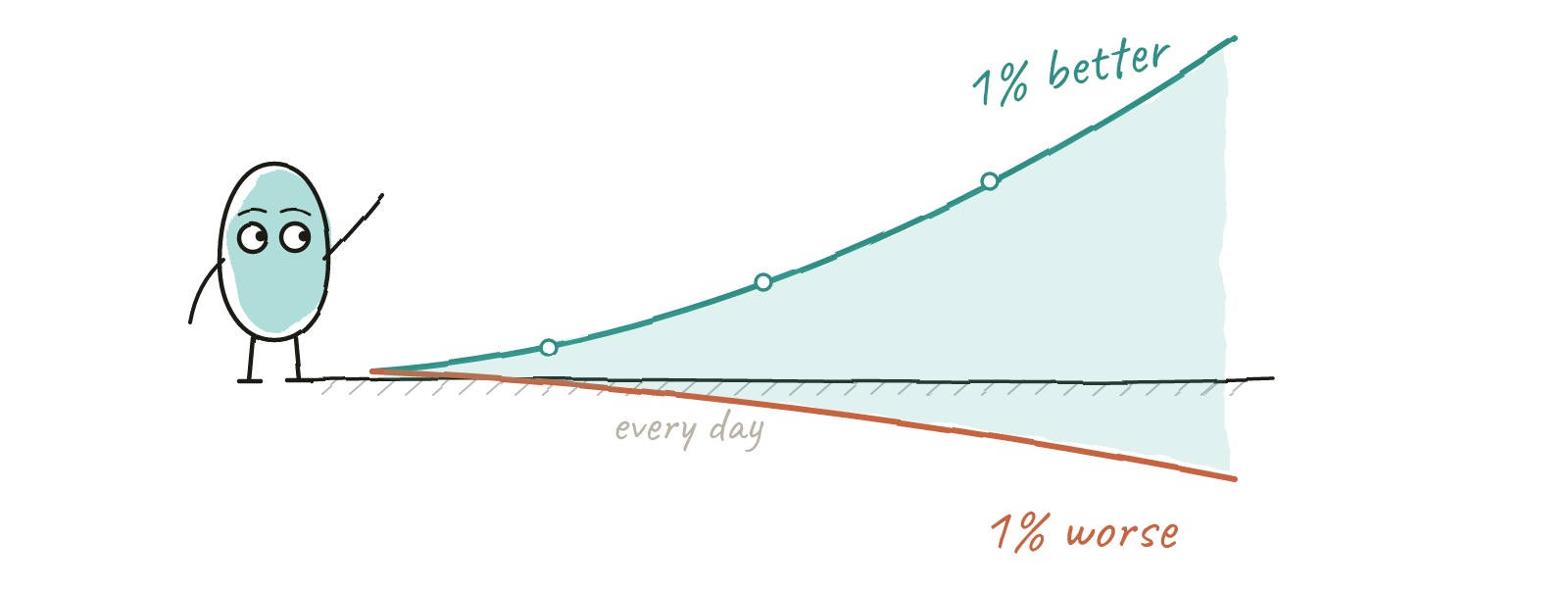
A single day of this tells you nothing. One healthy meal does not change the scale. One night of studying does not teach you Mandarin. One skipped workout does not make you unfit. That is exactly why the pattern is so easy to miss. Good choices and bad choices both feel too small to count, so you repeat them.
But habits work like compound interest, where money earns more money because the earlier earnings earn too. Your habits do the same. The effects pile on top of each other, and you only see the size of the pile years later.
Picture a plane flying from Los Angeles to New York. The pilot turns the nose just 3.5 degrees south. At takeoff, nothing looks different. By the end of the trip, the plane lands in Washington, D.C. A tiny turn, repeated over thousands of miles, puts you in a different city.
So the question is not where you are now. It is which way you are heading. A millionaire who spends more than they earn is on a bad path. A broke person who saves a little every month is on a good one.
Your results are a late report card on your habits. Your weight reports your eating habits, and your net worth reports your money habits.
You get what you repeat.
It cuts both ways. A little stress each day piles up into illness, and a little kindness in each talk builds a network of friends.
Progress hides before it shows
If small habits are so strong, why do most people quit?
Because the payoff comes late.
Picture an ice cube on a table in a freezing room. The room warms up slowly. At 26 degrees, nothing happens. At 28, nothing. At 31, nothing. Then, at 32 degrees, the ice starts to melt. The last degree was no bigger than the ones before it. But all the earlier heat was not wasted. It was being stored, and it had to build up before anything could change.
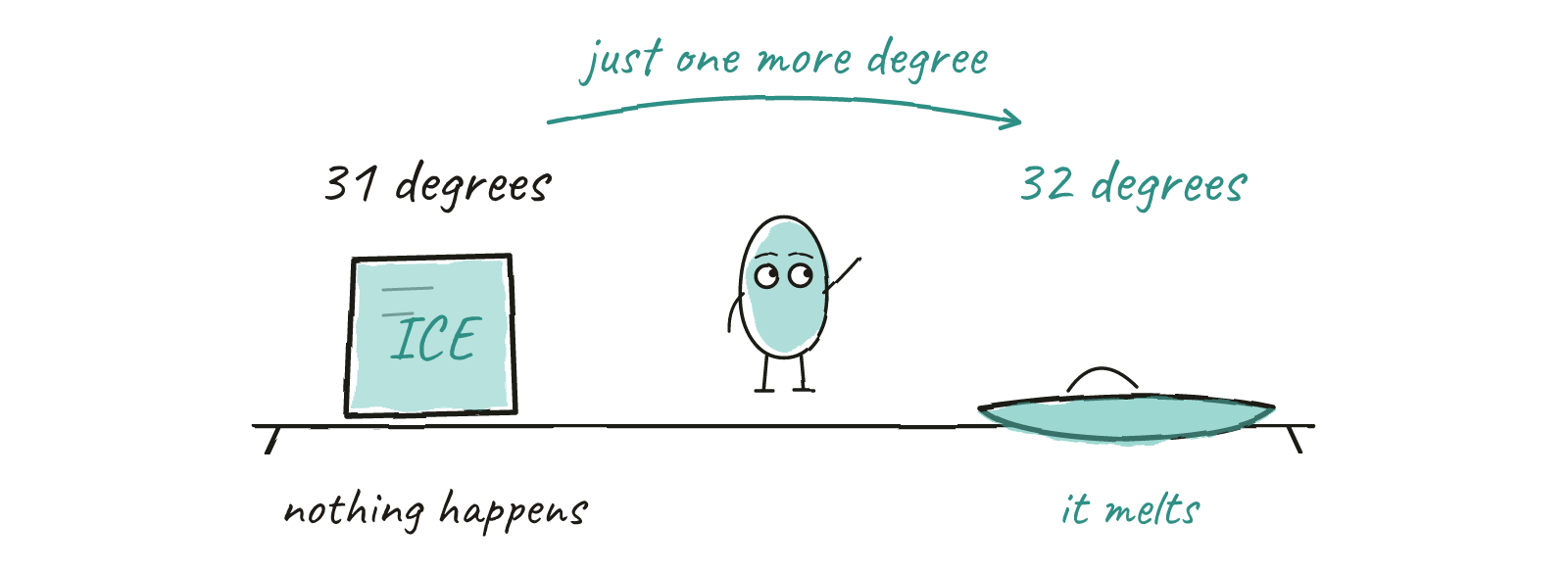
Habits work the same way. Bamboo shows almost nothing above ground for its first five years, while it builds roots underneath. Then it shoots up ninety feet in six weeks. The flat stretch is a Plateau of Latent Potential: you do the work and see no change. It feels like failure, but the effort is piling up.
You think, "I've been running every day for a month, so why can't I see any change in my body?" So you stop. You stopped at 31 degrees.
When someone finally breaks through, the world calls it an overnight success. They know better. The result came from the years when nothing seemed to happen.
You fall to the level of your systems
Most advice says to set a goal. Care more about your system. A goal is the result you want, like winning a championship. A system is what you do every day to get there: how you recruit, how you practice, how you review.
Goals still have a use. They point you in a direction. But on their own, they fail you in four ways.
First, winners and losers have the same goals. Every Olympic cyclist wants to win. The British team presumably wanted it in the years before, too. The goal was never the difference. The system was.
Second, reaching a goal changes your life only for a moment. Clean a messy room, and if your habits stay the same, the mess returns. You fixed the result and left the cause alone.
Third, goals put your happiness off. "Once I reach my goal, then I'll be happy" means you are never happy now. And it forces a narrow story: reach the goal and win, or miss it and fail.
Fourth, goals make you stop. Many runners train hard for months, cross the finish line, then quit training. When the goal is gone, so is the push.
A system does not end. You can feel good whenever it is running, and it keeps going after any single win. Clear says it plainly:
You do not rise to the level of your goals. You fall to the level of your systems.
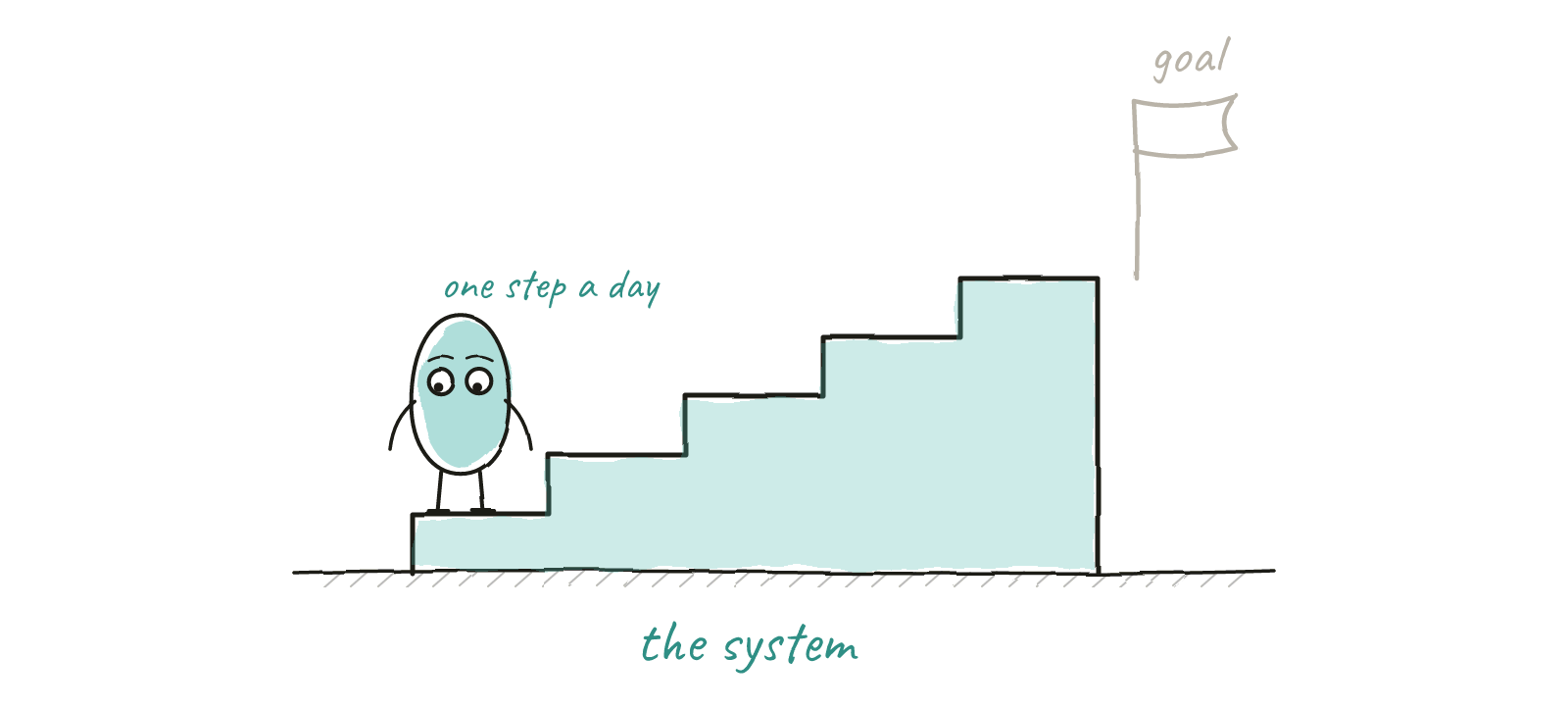
That also means that if you keep failing, you may not be the problem. The system may be the problem. Bad habits come back again and again, not because you do not want to change, but because you are using the wrong system.
Every action is a vote for who you are
Why do systems of small habits go so deep? Because they change the person doing them.
Think of change as an onion with three layers. The outer layer is outcomes: what you get, like a lost twenty pounds. The middle layer is process: what you do, like a new gym routine. The inner layer is identity: what you believe about yourself.
Most people start from the outside and work in. They pick a result, then a routine. Start from the inside instead. Ask not what you want, but who you want to be.
Here is the difference. Two people are offered a cigarette. One says, "No thanks. I'm trying to quit." That person still sees themselves as a smoker who is fighting it. The other says, "No thanks. I'm not a smoker." That is a different person, speaking from a different identity.
Identity decides what feels natural. Research found that people who thought of themselves as "a voter" were more likely to vote than people who only said they wanted to vote. When a habit matches who you think you are, you do not need to argue yourself into it.
An identity can also trap you. "I'm terrible with directions." "I'm not a morning person." "I'm always late." After years of repeating a story like that, you stop trying, because "that's not who I am."
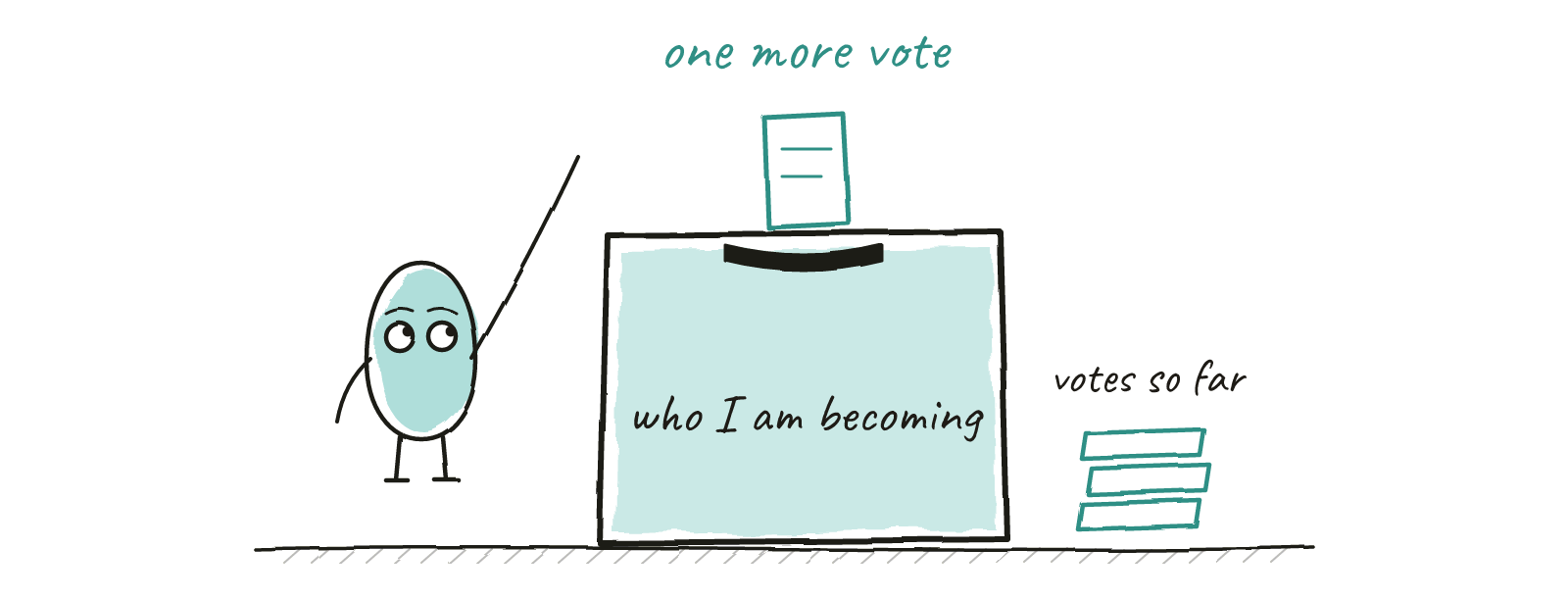
So where does identity come from? From what you repeat. Whatever you believe about yourself, you believe because you have proof. Go to the gym even in the snow, and you gather proof that you are committed. A single experience fades. A habit adds up. Every time you act, you cast a vote for the kind of person you are becoming.
You do not need every vote. In an election, you only need a majority. You can cast a few votes for the old you and still win. Each vote also teaches you to trust yourself.
This gives you a simple two-step plan.
- Decide who you want to be.
- Prove it to yourself with small wins.
One person lost over 100 pounds by asking one question all day: "What would a healthy person do?" Would a healthy person walk or take a cab? Order a burrito or a salad? Act like that person long enough, and you become that person.
That is why habits matter. They are not about having something.
They are about becoming someone.
Every habit runs on four steps
Now look at how a habit actually works.
In 1898, the psychologist Edward Thorndike put cats in puzzle boxes. To get out and reach food, a cat had to pull a cord or press a lever. At first the cats clawed and poked at random. By luck, one pressed the lever and the door opened. Over twenty to thirty tries, the cats got faster. One cat's first three escapes averaged about 1.5 minutes. Its last three averaged 6.3 seconds.
Your brain learns the same way. It tries something, gets a reward, and remembers what came just before. After enough repeats, the choice becomes automatic. A habit is a solution to a problem that keeps coming back.
That is useful because your conscious mind can only handle one problem at a time. Habits take the routine work off your plate. People worry that habits make life dull, but it is the other way round. When the basics run on their own, your mind is free for new things.
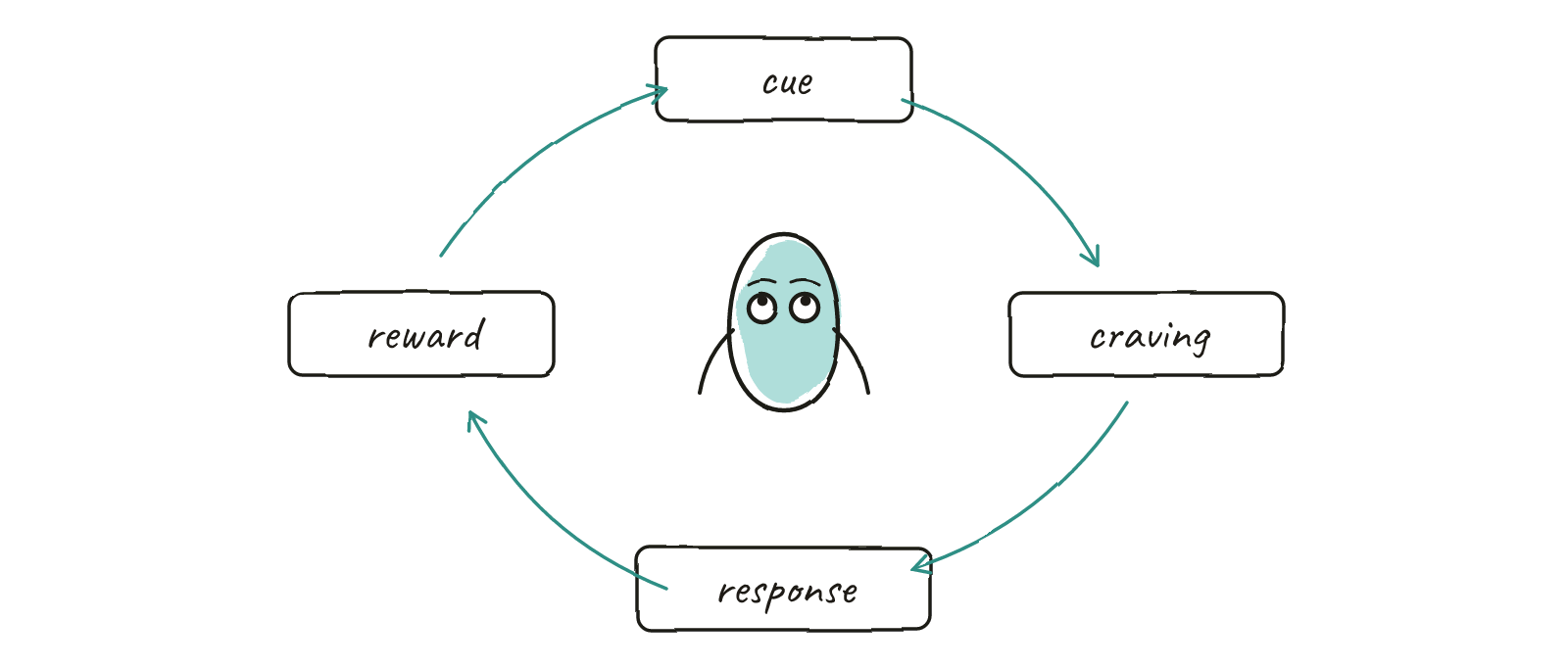
Every habit runs on the same four steps, in the same order:
- Cue. A signal that predicts a reward. Your phone buzzes.
- Craving. The wish for a change in how you feel. You want to know what the message says.
- Response. The thing you actually do. You pick up the phone.
- Reward. What you get. Your craving is gone, and your brain notes: next time the phone buzzes, grab it.
Notice the craving. You do not crave the cigarette. You crave the relief it gives. You do not crave the television. You crave being entertained.
Every craving is a wish to feel different from how you feel now.
If any step is missing, the habit dies. No cue, and the habit never starts. No craving, and you have no reason to act. If it is too hard, you will not do it. If it does not reward you, you will not repeat it.
That gives you four levers. To build a good habit, make it obvious, make it attractive, make it easy and make it satisfying. To break a bad one, flip each rule: make it invisible, unattractive, hard and unsatisfying. The rest of this LongForm takes these four rules one at a time.
Make it obvious: see your habits before you change them
Most habits run without you noticing. A paramedic once looked at her father-in-law at a family party and told him to go to the hospital. He felt fine. He had a blocked artery, and she had learned the signs without knowing it. Your brain picks up cues the same way, and it can act on them before you are aware of them.
That is also the danger. You can do things on autopilot. A shop clerk, told to cut up used gift cards, once cut a customer's real credit card in half.
So change starts with awareness. Japanese train operators point at things and call out what they see, such as "Signal is green." This reduces errors by up to 85 percent and accidents by 30 percent. You can do something similar. Write a list of your daily habits, and mark each one as helping you (+), hurting you (−) or neutral (=). Do not judge yourself. Just watch, as if you were watching someone else.
One note on labels. A habit is good or bad by what it does for the person you want to be. Ask: does this habit vote for the person I want to become, or against?
Give your habit a time and a place
In 2001, researchers in Britain asked 248 people to build an exercise habit over two weeks. One group simply tracked their workouts. A second group also read about the health benefits of exercise. A third group read the same material and also wrote down when and where they would exercise: "During the next week, I will partake in at least 20 minutes of vigorous exercise on [day] at [time] in [place]."
In the first two groups, 35 to 38 percent exercised at least once a week. The extra reading did nothing.
In the third group, 91 percent did.
A plan like that is called an implementation intention. It just means deciding ahead of time when and where you will act. The fix was not more motivation. It was clarity. "I want to work out more" is a wish. "I will exercise for one hour at 5 p.m. in my local gym" is a plan. When the moment arrives, you do not have to decide. You just follow the plan.
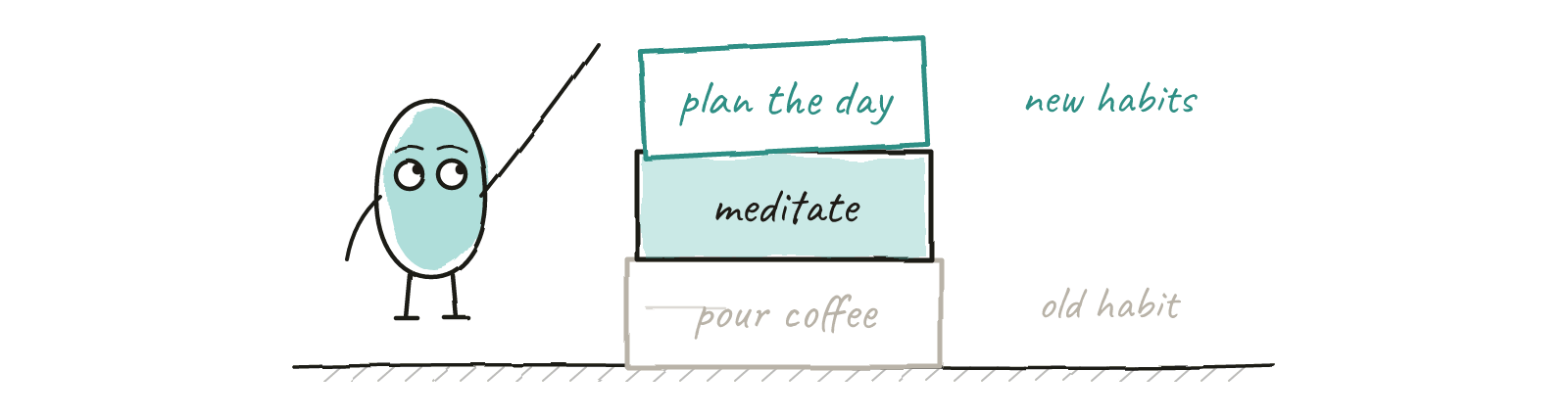
A second way is habit stacking, an idea from the researcher BJ Fogg. It means you tie a new habit to one you already do every day: "After I [current habit], I will [new habit]." For example, "After I pour my cup of coffee each morning, I will meditate for one minute."
It works because actions already lead to one another. In 1765, the philosopher Denis Diderot bought a scarlet robe, and soon replaced his rug, his chair and more to match it. That chain is now called the Diderot Effect: one action triggers the next. Stack your new habit on the end of an old one, and the old one becomes its cue.
Shape your surroundings, because they shape you
Anne Thorndike, a doctor at a Boston hospital, changed what people ate without saying a word to them. She added bottled water next to the registers and the food stations in the cafeteria, while soda stayed in its fridge. In three months, soda sales dropped 11.4 percent and water sales rose 25.8 percent.
People often pick things because of where they are, not what they are. You eat the cookie that is on the counter. Of all your senses, vision is the strongest. About ten million of your eleven million sensory receptors serve your eyes. So a small change in what you see can change what you do.
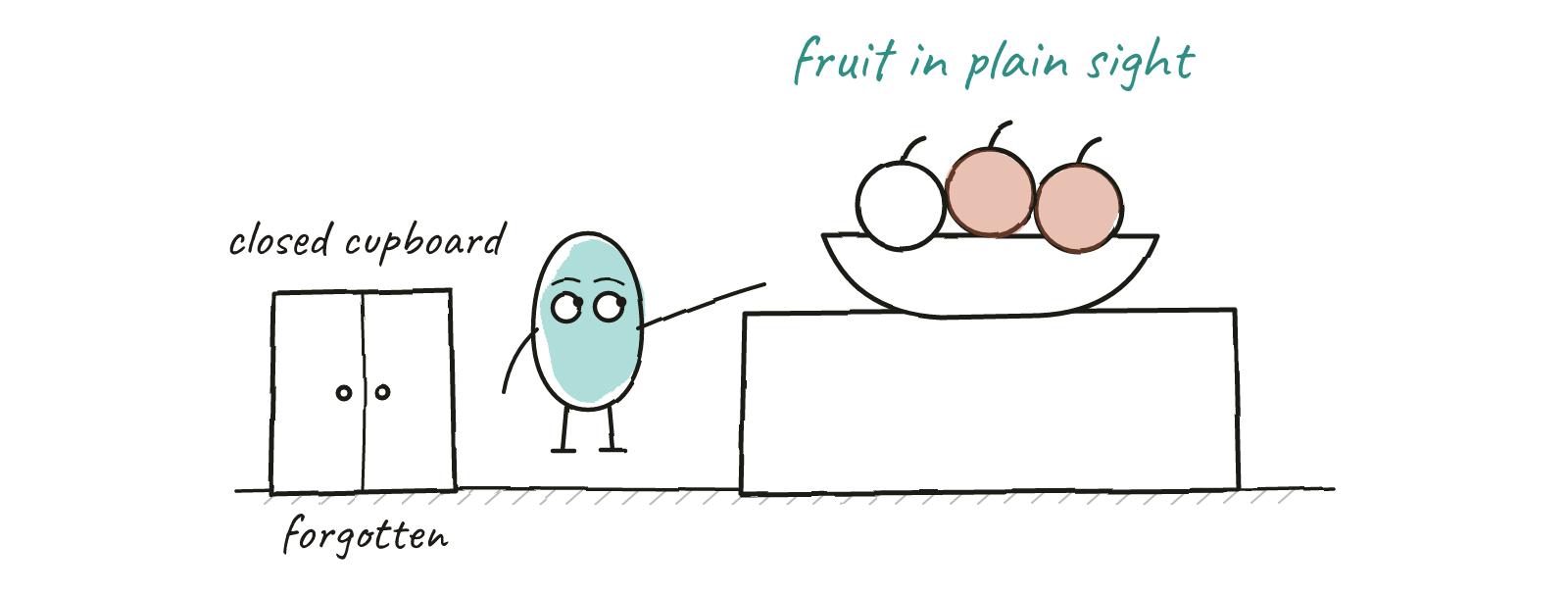
You can use this. If you want to eat more fruit, put it in a bowl in the middle of the kitchen. If you want to play guitar, keep the guitar out on a stand. Put the pill bottle by the faucet. The cue has to be hard to miss.
Habits also attach to places. People who could not sleep were told to get into bed only when tired, and to sit in another room if sleep would not come. In time their brains learned that the bed meant sleep. The rule is "One space, one use." Work in one place, eat in another, sleep in another. When you mix uses, you mix habits, and the easy habit wins.
Self-control is a weak plan
In 1971, two congressmen learned that over 15 percent of U.S. soldiers in Vietnam were heroin addicts. The researcher Lee Robins then followed the soldiers home and found something surprising. Only 5 percent of the soldiers who had used heroin there became addicted again within a year, and 12 percent within three years. About eight in ten simply stopped.
In Vietnam, the cues were everywhere: the drug, the stress, the other users, the distance from home. At home, the cues were gone. When the setting changed, so did the habit. By contrast, people who go to rehab usually go back to their old neighborhoods and their old triggers. Typically, 90 percent become addicted again.
This changes how to think about willpower. People who seem to have great self-control turn out not to be very different from people who struggle. They just spend less time near temptation.
The people with the best self-control are usually the ones who need it the least.
Once a habit is formed, you are unlikely to forget it. A therapist who quit smoking and stopped riding horses for years felt a craving when she climbed on a horse again. The cue was still stored in her memory. So fighting temptation again and again is a losing plan. It costs too much energy.
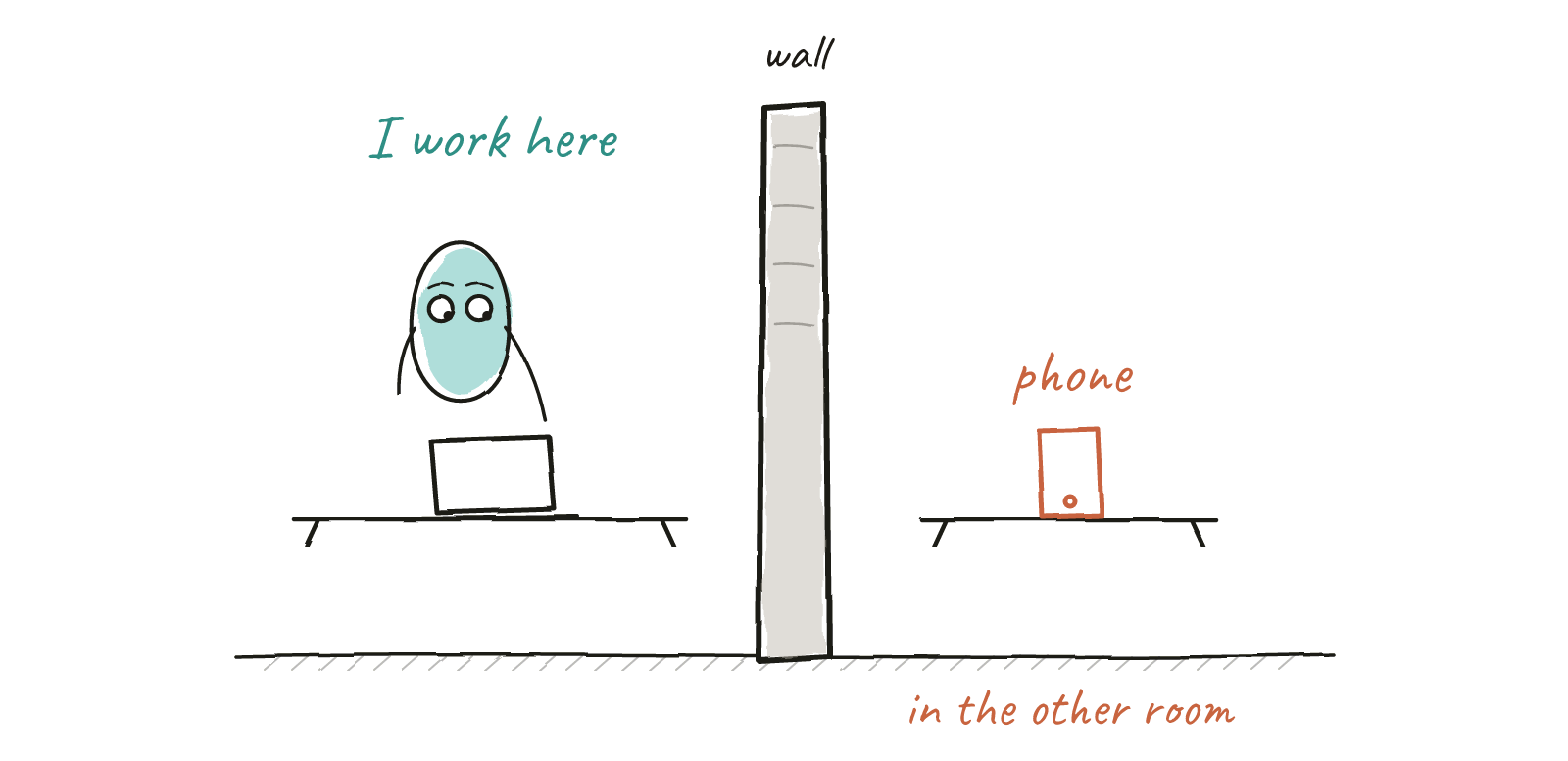
The better plan is to remove the cue. Leave your phone in another room while you work. Take the TV out of the bedroom. Unfollow the accounts that make you feel small. Make the bad habit invisible.
Make it attractive: you want things before you get them
The second law is about desire. Why do we find some things so hard to resist?
The Dutch scientist Niko Tinbergen showed that animals have built-in rules, and that exaggerated versions of those rules hijack them. Herring gull chicks peck at the red dot on a parent's beak. Tinbergen offered them a fake cardboard beak with three red dots, and they went wild for it.
Humans have the same weakness. Our brains still love salt, sugar and fat, which were rare when our ancestors were hunting and foraging. Food companies now use that. They search for the "bliss point" of a product, the exact mix that keeps you coming back. Social media gives you more likes and praise in minutes than you could ever get at the office or at home. These are exaggerated signals, and our instincts go wild for them.
The brain chemical behind this is dopamine, which makes you want things. In 1954, researchers blocked dopamine in rats. The rats lost all will to live and stopped eating and drinking. Yet when sugar was put in their mouths, they still seemed to enjoy it. They could still like things. They just did not want them anymore.
Dopamine is released when you expect a reward, not only when you get one. A gambler gets the spike before placing the bet, not after winning. So it is anticipation that gets you moving, and the brain gives far more space to wanting than to liking. To make a habit stick, make it something you look forward to.
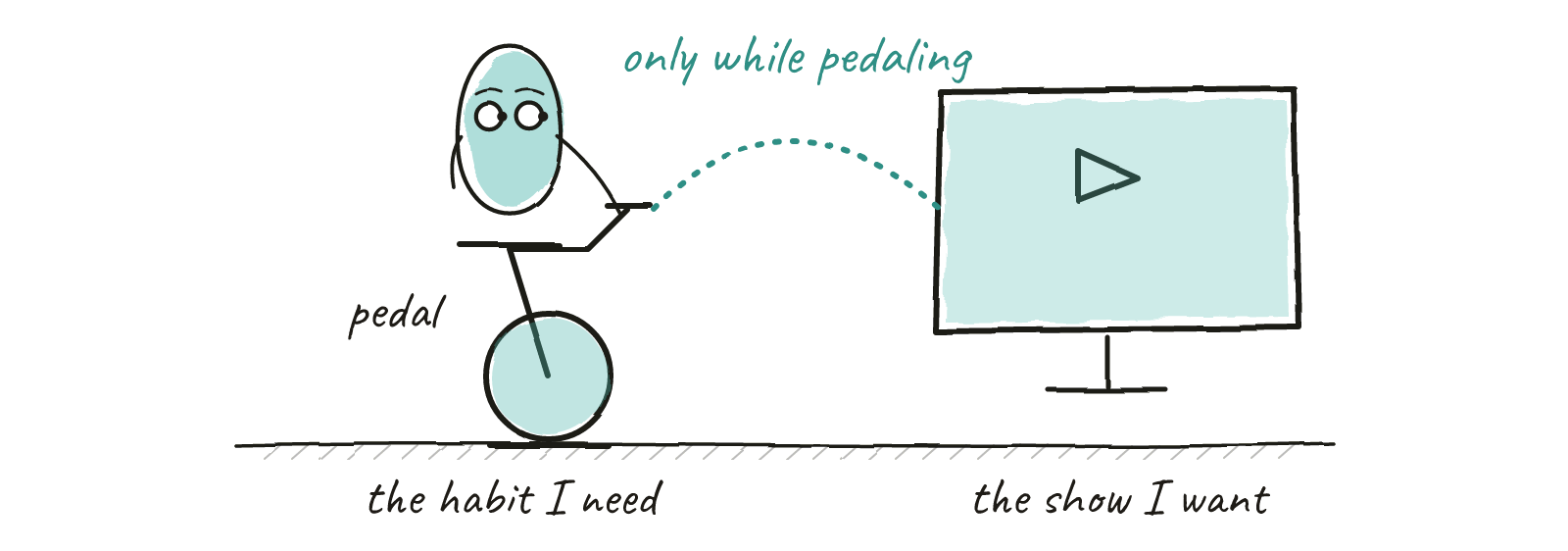
One way is temptation bundling: pair something you need to do with something you want to do. Ronan Byrne, an engineering student in Dublin, wired his exercise bike to his laptop so that Netflix would play only while he was pedaling fast enough. Stacked with the earlier tool, the rule becomes: after you do the thing you need, you do the thing you want.
The people around you set what feels normal
We copy the people around us, and most of us would rather fit in than be right.
Laszlo Polgar believed that anyone could become a genius with the right training. He tested it on his three daughters, Susan, Sofia and Judit, and he made chess the center of their home. At fifteen years and four months, Judit became the youngest grandmaster of all time. The sisters describe it as fun, not grueling. Their world praised chess, so chess was attractive.
We imitate three groups: the close, the many and the powerful. A study that tracked 12,000 people for thirty-two years found that a person was 57 percent more likely to become obese if a friend did. In the 1950s, Solomon Asch asked people to match line lengths, an easy task. When a group of planted actors gave a wrong answer on purpose, nearly 75 percent of the subjects went along with it. We want to be accepted, even when it means being wrong.
So join a group where your habit is normal. Pick people who already share something with you, like a hobby or a taste, and then add the habit. Nothing sustains motivation like belonging.
Reframe a habit so it feels worth doing
Behind every craving sits an older motive: to get food, to find love, to win approval, to cut uncertainty, to gain status. Your habits are modern ways to solve ancient wants. Checking Instagram scratches the itch for approval. Searching Google reduces uncertainty.
Your brain predicts how it will feel before it acts. That prediction is what creates the craving. So if you change the prediction, you change the craving.
One easy way is to change one word. Instead of saying you have to, say you get to. You get to wake up early. You get to make another sales call. Both versions are true. You pick the one that gives you energy. A nervous speaker can read a racing heart as fear or as excitement, and "I am excited" helps more.
You can also build a small ritual that you enjoy just before a hard habit. The boxer Ed Latimore found that putting on headphones sharpened his focus, even with no music playing. He had linked the headphones with good work.
Start with reps, not a perfect plan
The third law is about ease. A photography teacher, Jerry Uelsmann, split his class in two. One half would be graded on the quantity of photos they took. A hundred photos earned an A. The other half would be graded on quality, and needed only one perfect photo. At the end, the best photos all came from the quantity group. They had been busy shooting, learning and fixing mistakes. The quality group had spent the term theorizing about perfection.
There is a difference between motion and action. Planning, researching and brainstorming are motion. Taking the photo, writing the page, eating the healthy meal is action. Motion feels like progress while it keeps you safe from failing.
But only action gets results.
How long does it take to form a habit? That is the wrong question. Habits form by repetition, not by time. It does not matter whether it takes twenty-one days or three hundred. What matters is how many times you do it. With enough reps, the brain physically changes. London taxi drivers have a larger hippocampus, the part of the brain tied to spatial memory, than other people, and it shrank when a driver retired.
Make the right thing the easy thing
Humans follow the Law of Least Effort. Given two options, we pick the easier one. This is not a flaw. Energy is precious, and the brain saves it. So a hundred push-ups a day will wear you out in a few days. One push-up a day costs almost nothing, so you will do it.
Do not fight this. Use it. Think of a garden hose with a bend in it. You can crank up the valve and force more water through, or you can take out the bend. Forcing is motivation. Removing the bend is lowering friction.
When the British government linked directly to the tax form instead of sending people to a web page to download it, the response rate rose from 19.2 percent to 23.4 percent. One step fewer was worth millions in tax revenue.
Apply it to yourself. Pick a gym that is on your way to work. Lay out your workout clothes the night before. Oswald Nuckols "resets" each room when he leaves it, so everything is ready next time. He calls it being proactively lazy. And do the reverse for bad habits. Unplug the TV after each use. Clear leaves his phone in another room until lunch and gets three to four hours of work without a break.
Win the first two minutes
The dancer Twyla Tharp starts each day by hailing a cab to the gym at 5:30 a.m. She says the ritual is not the workout. The ritual is the cab. Once she has told the driver where to go, the rest follows.
Your day has a few moments like this. These are decisive moments. Do you order takeout or cook? Start the homework or pick up the game controller? Each is a fork in the road, and what you choose shapes what comes next. Habits are the entry point, not the end point.
They are the cab, not the gym.
This leads to the Two-Minute Rule: when you start a new habit, it should take less than two minutes. "Read before bed" becomes "Read one page." "Run three miles" becomes "Tie my running shoes." "Study for class" becomes "Open my notes."
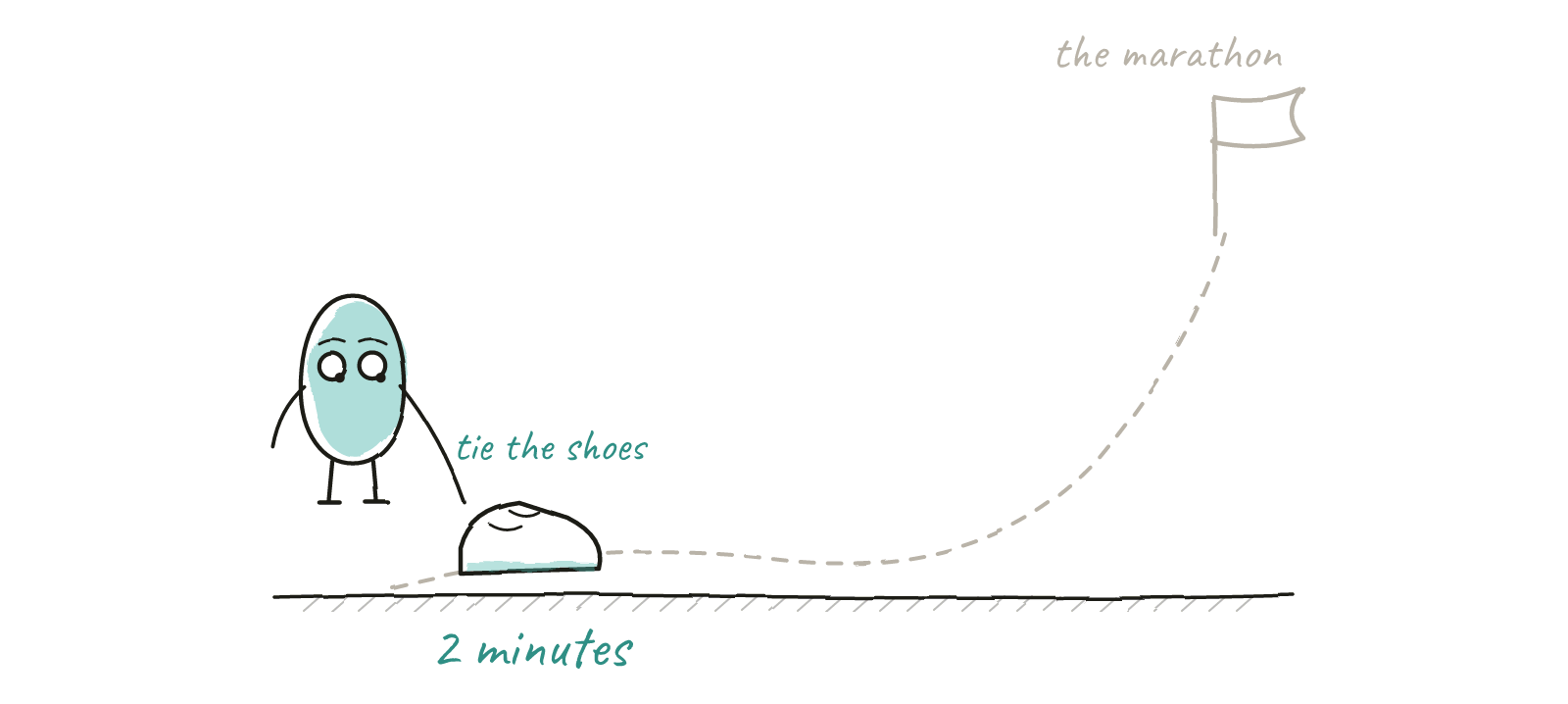
It sounds like a trick. But the point is to master showing up. A habit has to exist before you can improve it. Clear writes, "You have to standardize before you can optimize." One reader used this to lose over 100 pounds. At first, the reader allowed only five minutes at the gym each day. After a few weeks came the thought, "Well, I'm always coming here anyway. I might as well start staying a little longer."
When you are ready, you can scale up one small step at a time.
Lock in the habit before temptation arrives
Sometimes the best move is to make bad habits hard. Victor Hugo, by legend, had an assistant lock away all his clothes so he could not go out and had to write. His book was published two weeks early. A choice you make now that controls what you can do later is a commitment device. A friend of Clear's plugs his internet router into a timer that cuts power at 10 p.m. Clear asks the waiter to box half his meal before it arrives.
You can go further and automate. John Henry Patterson owned a store where employees were stealing. He bought two of the first cash registers, which locked the money away after each sale. The theft ended overnight, and in six months the store went from losing money to making $5,000 in profit. He bought the rights to the machine and started the National Cash Register Company.
A few one-time choices pay off again and again, like setting up automatic savings or deleting social media apps from your phone. Technology can also work against you. Autoplay keeps you watching because stopping takes more effort than continuing.
Make it satisfying: what is rewarded is repeated
The fourth law is about the ending. In the late 1990s, the public health worker Stephen Luby went to Karachi, Pakistan, to fight disease in the slums. He found that handwashing could help, and that people already knew it mattered. They just did not do it consistently. Luby's team gave them Safeguard soap, which foamed well and smelled good. Handwashing became a little more pleasant. Diarrhea fell by 53 percent, pneumonia by 50 percent and the skin infection impetigo by 34 percent. Six years later, over 95 percent of the households that got the free soap still had a handwashing station with soap and water.
Clear calls this the Cardinal Rule of Behavior Change: what is rewarded is repeated, and what is punished is avoided.
Here is the catch. Our brains evolved for a world where actions paid off right away. Modern life pays off late: your paycheck comes in weeks, your fitness in months, your retirement in decades. The costs of good habits come now. The costs of bad habits come later. A cigarette relieves stress today and may harm you in ten years. So the brain votes for now.
The fix is to add a bit of reward right away. Some habits mean not doing something, and then nothing visibly happens. Open a savings account and name it "Leather Jacket." Each time you skip a purchase, move that amount into it. Now doing nothing pays you. One couple skipped restaurants and moved $50 each time into an account called "Trip to Europe." Choose rewards that match the person you want to be. If your reward for running is a bowl of ice cream, you are voting for two different people.
Track your progress, and never miss twice
Trent Dyrsmid, a young stockbroker, started each day with two jars on his desk. One held 120 paper clips. After each sales call, he moved one clip to the empty jar. In eighteen months he was bringing in $5 million to the firm.
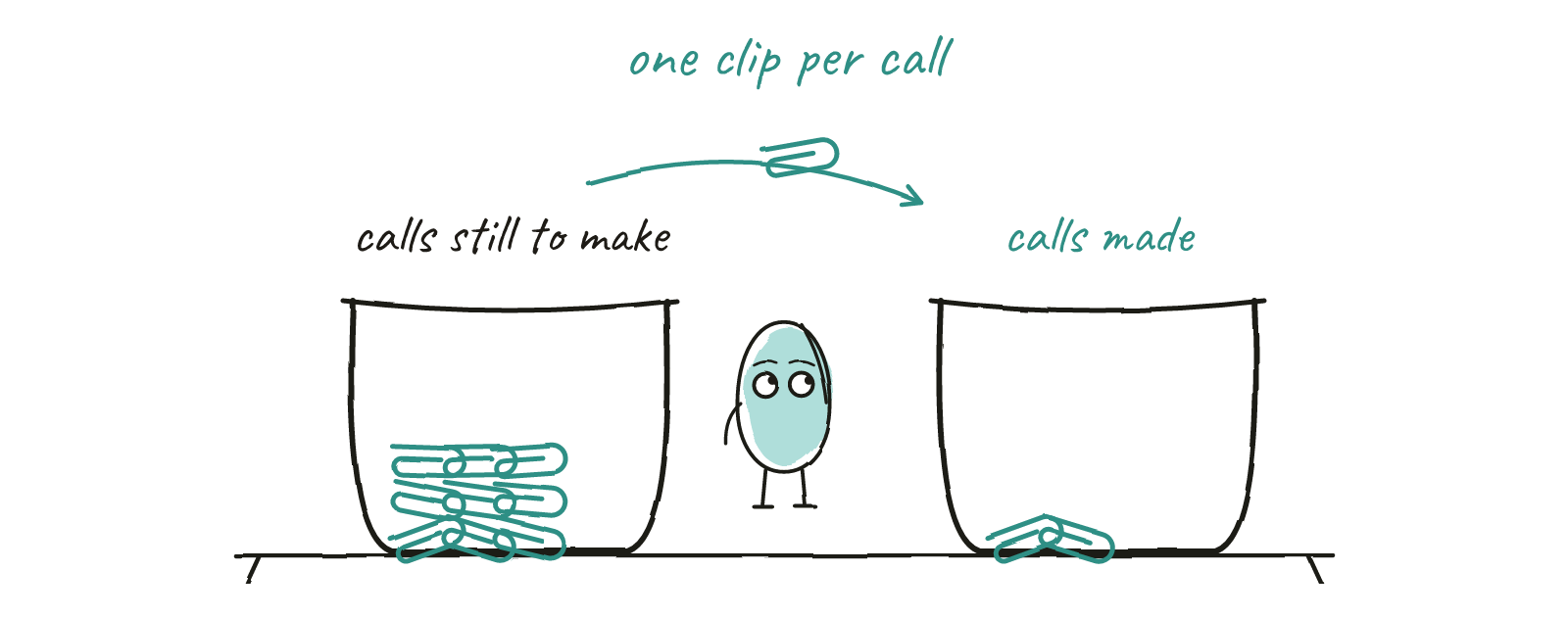
Seeing progress feels good. A habit tracker, such as a calendar where you mark an X each day, does this. Jerry Seinfeld's rule for writing jokes is to "never break the chain." Tracking helps in three ways. The streak is a visual cue. It is motivating, because you do not want to lose it. And marking the X is its own small reward. In one study of over 1,600 people, those who kept a daily food log lost twice as much weight as those who did not.
Slips will happen, and what you do next matters most. Follow one rule: never miss twice.
Missing once is an accident. Missing twice is the start of a new habit.
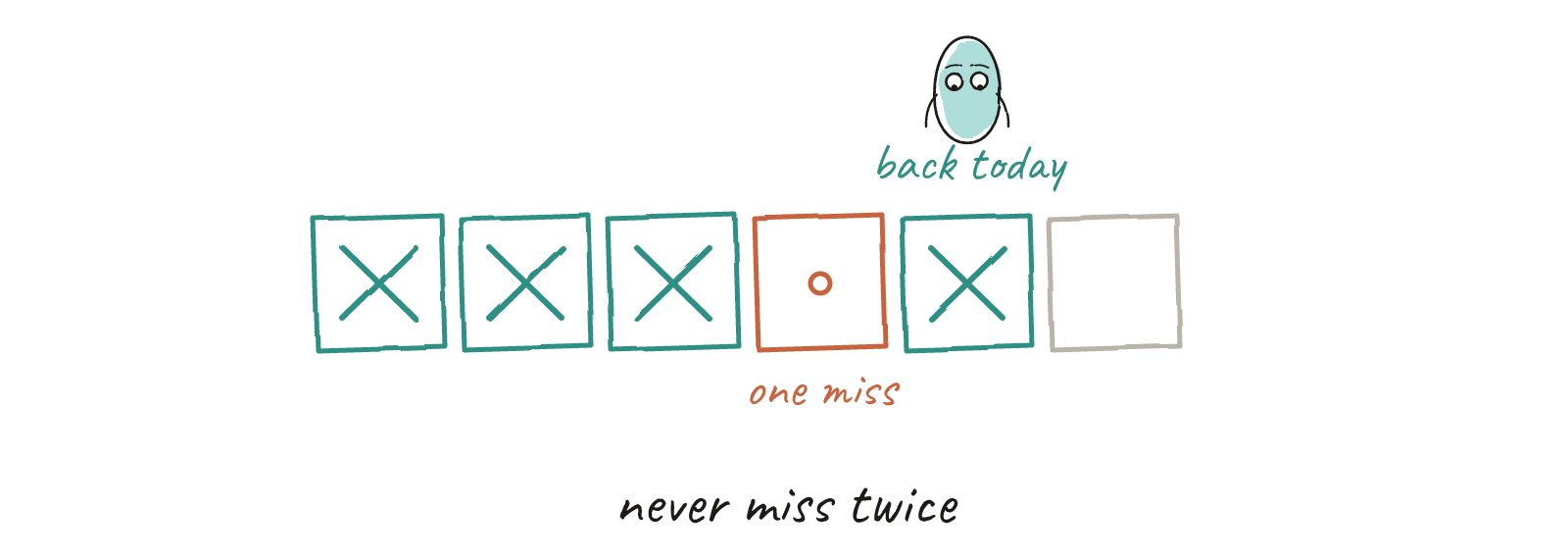
Bad days count for a reason. Lose a third of your money and you need a 50 percent gain on what is left to get back. Lost days hurt you more than good days help you, so do the small version on the days you feel awful. A five-minute workout keeps the compounding alive and keeps your identity: you are a person who shows up.
A warning about numbers. People chase whatever they measure. When you only chase a number, the number stops telling you the truth. Goodhart's Law says that when a measure becomes a target, it ceases to be a good measure. If you only chase the number on the scale, you may reach for crash diets. Track what matters, and when one number stalls, look at another sign of progress.
Let someone watch you
Pain teaches fast. The negotiator Roger Fisher once proposed putting the president's nuclear launch code in a capsule next to a volunteer's heart, so firing the weapons would first mean killing a person. A consequence that is near and vivid changes behavior.
You can add a cost to a bad habit with a habit contract. You write down your habit and what happens if you break it, and one or two people sign it with you. Bryan Harris, an entrepreneur, wrote a contract with his wife and trainer. If he missed a day of logging his food, he had to pay his trainer $200, and he had to dress up for work every day for the rest of the quarter. He lost the weight.
Even a plain accountability partner helps. Knowing someone is watching makes skipping costly. You do not want to look untrustworthy.
Pick the game where the odds favor you
Past the basics, there is a question of how to go from good to great.
Michael Phelps is widely seen as one of the greatest athletes in history. Hicham El Guerrouj is one of the greatest middle-distance runners of all time. Phelps is 6 feet 4 inches. El Guerrouj is 5 feet 9. Yet they wear the same inseam. Phelps has a long torso and short legs, which suits swimming. El Guerrouj has long legs and a short torso, which suits running. Swap their sports, and neither would likely reach the Olympics.
Genes do not set your fate. They shape where your best chances lie. Habits are easier and more rewarding when they fit your nature. So build habits that suit you. If you hate lifting weights, try rock climbing. If you want to read more, read what you love, even if it is romance novels.
How do you find your game? Explore first. Try many things. Then put most of your effort, about 80 to 90 percent, into what works, and keep exploring with the rest. Ask yourself: What feels like fun to me but work to others? What makes me lose track of time? Where do I get better results than most people?
If you cannot find a game you can win, build one. The cartoonist Scott Adams says he draws better than most people and is funnier than most people, but he is not the best at either. Few people can do both, and he adds a business background on top. A great player does not just win the game everyone plays. They create a game that favors their strengths.
Boredom is the real enemy
A boy who sold guidebooks at Disneyland in 1955 became the comedian Steve Martin. He spent about fifteen years working his way up, adding a minute or two to his act each year. In Martin's own words, it was ten years spent learning, four years refining and four years as a wild success.
The Goldilocks Rule explains why such growth works. We stay motivated when a task sits at the edge of our ability. Not too easy, not too hard, just right. Play tennis against a four-year-old and you get bored. Play against Serena Williams and you give up. Play someone about as good as you and you are fully absorbed.
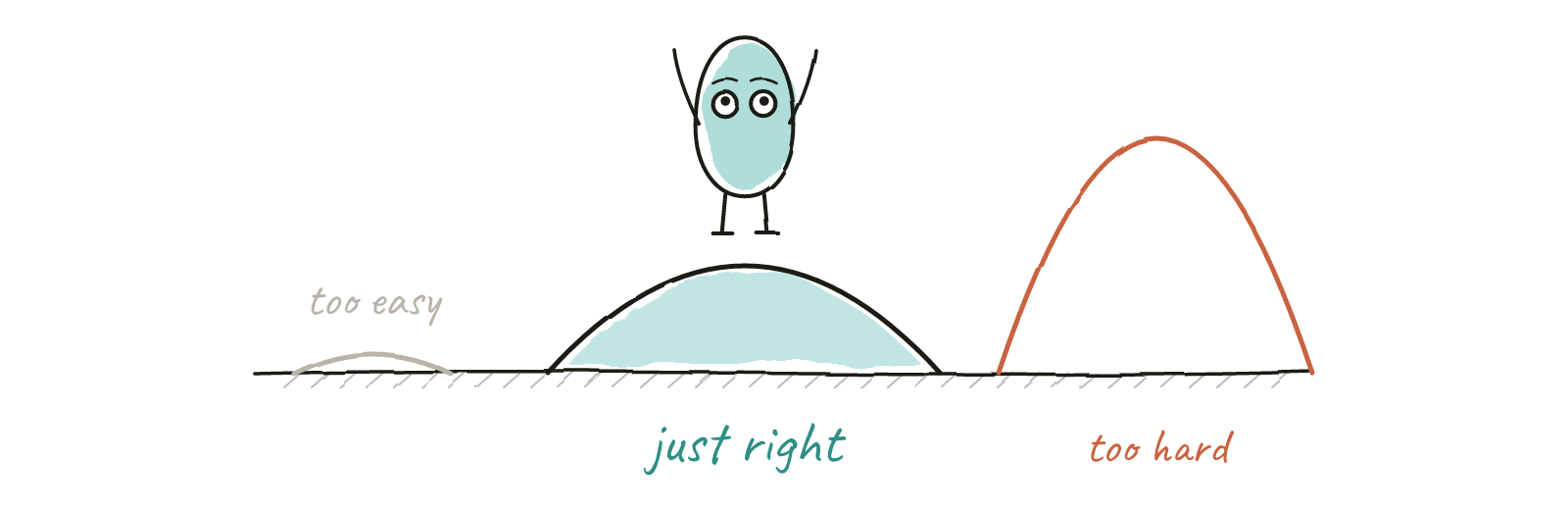
But even a well-set challenge turns dull. A weightlifting coach told Clear that at some point it comes down to who can handle the boredom of training every day, doing the same lifts over and over. The biggest threat to your progress is not failure but boredom. When things feel routine, you look for something new, and the old plan gets dropped even while it still works.
Professionals show up when they do not feel like it. Amateurs let life get in the way.
You have to fall in love with boredom.
Habits need review, or they go stale
Habits create mastery, but they have a cost. Once a skill is automatic, you stop noticing small mistakes. You think you are improving, when you are only repeating. You need habits and deliberate practice together. Deliberate practice means working on your weak spots on purpose. Master one small skill until it is automatic, then move to the next.
You also need review. In 1986, the Los Angeles Lakers had a roster full of stars and still lost in the playoffs. Their coach, Pat Riley, built a program to track each player's numbers and asked every player to improve by at least 1 percent over the season. Eight months after the program began, the Lakers were NBA champions, and they won again the next year. The point was not the numbers. It was knowing where you stand.
Clear does a yearly review each December: what went well, what did not and what he learned. Six months later, he checks whether he has lived by his values. A few hours a year keeps him from drifting. Think of a mirror. From an inch away you see every flaw. If you never look, you miss a spot on your shirt. Look from a normal distance.
And the same identity that powers your habits can hold you back. If you tie your whole self to one label, such as athlete or CEO, you break when that role ends. Clear lived this after baseball. The fix is to keep your identity small and flexible: "I'm an athlete" becomes "I'm the type of person who is mentally tough and loves a physical challenge." You keep who you are even when your role changes.
There is no finish line
An old Greek puzzle asks whether one coin can make a person rich. Ten coins do not. Add another, and another. At some point you must admit that one coin did it. One tiny habit will not change your life either, but a thousand of them will.
Success is not a finish line. It is a system you keep improving. Whenever you stall, run through the four laws and find the bottleneck. Is the habit hard to remember? Make it obvious. Not tempting? Make it attractive. Too hard? Make it easy. Not rewarding? Make it satisfying. Then repeat, looking for the next 1 percent.
One last thing sits behind the four laws. Desire starts a behavior, and pleasure keeps it going. The first three laws get you to act this time. The fourth gets you to act again next time.
Small habits do not just add up. They compound.
Get the next one on Sunday.
A free weekly LongForm, in your inbox.